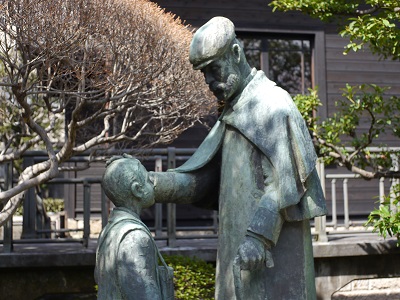
In Tokyo, history rarely announces itself with grand monuments alone. Instead, it lingers in subtle places — in narrow streets, quiet shrines, and especially in slopes that travelers might walk without noticing. Around Nogi Shrine, visitors can experience one of these uniquely Japanese ways of preserving memory through landscape.
The shrine stands on land once associated with Nogi Maresuke, a military figure from Japan’s modernization period in the late nineteenth and early twentieth centuries. Today, the shrine feels calm and introspective, surrounded by modern office towers and city traffic. This contrast reflects a common Japanese aesthetic: the coexistence of rapid urban life and deeply rooted historical consciousness.
Nearby lies Nogizaka, a gentle hill whose name preserves the memory of the general. In many cities, slopes are simply geographical features. In Japan, however, slopes often carry names, legends, or historical associations. They function as small cultural archives embedded in the terrain.
To understand why slopes matter so much, it helps to know that Tokyo developed from the older city of Edo. Edo was built across a landscape of plateaus and lowlands. These natural elevations shaped social life. Samurai residences were often located on higher ground, while merchants and craftsmen lived in lower areas. Slopes physically connected these worlds, allowing people to move between different social and cultural environments.
Walking up a slope in Tokyo can therefore feel like crossing invisible historical borders. The shift in elevation subtly changes perspective, sound, and atmosphere. Many visitors describe a quiet sense of transition when climbing these hills, as if the city is gently revealing another layer of itself.
Nogizaka offers this experience in a particularly poetic way. As visitors move between the shrine and the surrounding neighborhood, they are also moving through time. The slope remains even as buildings, transportation systems, and lifestyles transform around it. Unlike architecture, which can be replaced or rebuilt, the shape of the land endures. Because of this, slopes often serve as one of Tokyo’s most reliable storytellers.
Exploring places like Nogi Shrine and Nogizaka invites travelers to see Japan beyond famous landmarks or popular shopping districts. It encourages a slower form of tourism — one that values walking, observing, and sensing how history quietly survives within daily life. In Japan, cultural memory is rarely separated from the physical environment. Instead, it is woven into the streets beneath one’s feet.
For visitors willing to pause and walk thoughtfully, Tokyo’s slopes reveal a city that is not only modern and dynamic, but also deeply reflective — a place where geography and memory continue to shape each other across centuries.

コメント